Introduction — Problem statement
Denials bleed revenue.
Unchecked benefit verification causes real pain. Rising denials, slower reimbursements, and burned-out staff are the result.
This guide explains how revenue cycle management, accurate verification, and insurance and benefit verification stop denials before they start.
You’ll get the AVA framework, a practical step-by-step plan, common mistakes to avoid, ROI metrics to track, and a checklist/demo offer to pilot the program.
Why benefit verification matters
The denial cascade: root causes
Many denials start upstream: incorrect eligibility, expired coverage, wrong benefit limits, or missing pre-authorizations.
Those front-end errors cascade into claims rework, appeals, and lost revenue.
Waystar outlines common denial drivers that often trace back to registration issues Waystar denial causes & prevention.
Each denied claim often costs hours of staff time and hundreds in operational expense. MGMA gives useful benchmarks on the cost and time burden associated with denials MGMA denial cost benchmarks. Track these costs before you automate — numbers make the case to leadership.
Clinical and financial touchpoints at risk
Verification touches scheduling, registration, eligibility checks, authorizations, and coding.
An error at registration multiplies across the billing workflow and shows up as a denial weeks later.
Use payer portals and CMS resources to align processes; CMS has guidance for provider enrollment and directory accuracy CMS provider enrollment & directory guidance. Avaneer Health shows practical directory synchronization strategies you can borrow Avaneer provider data.
How verification reduces denials
Verify eligibility and benefits. Confirm necessary authorizations. Code correctly. Submit cleaner claims.
When verification is reliable, the backend sees fewer exceptions and fewer appeals.
Experian Health shares denial patterns that improve when front-end automation is applied Experian Health claims & denial insights. Start by tracking baseline denial reasons so you know which checks to automate first.
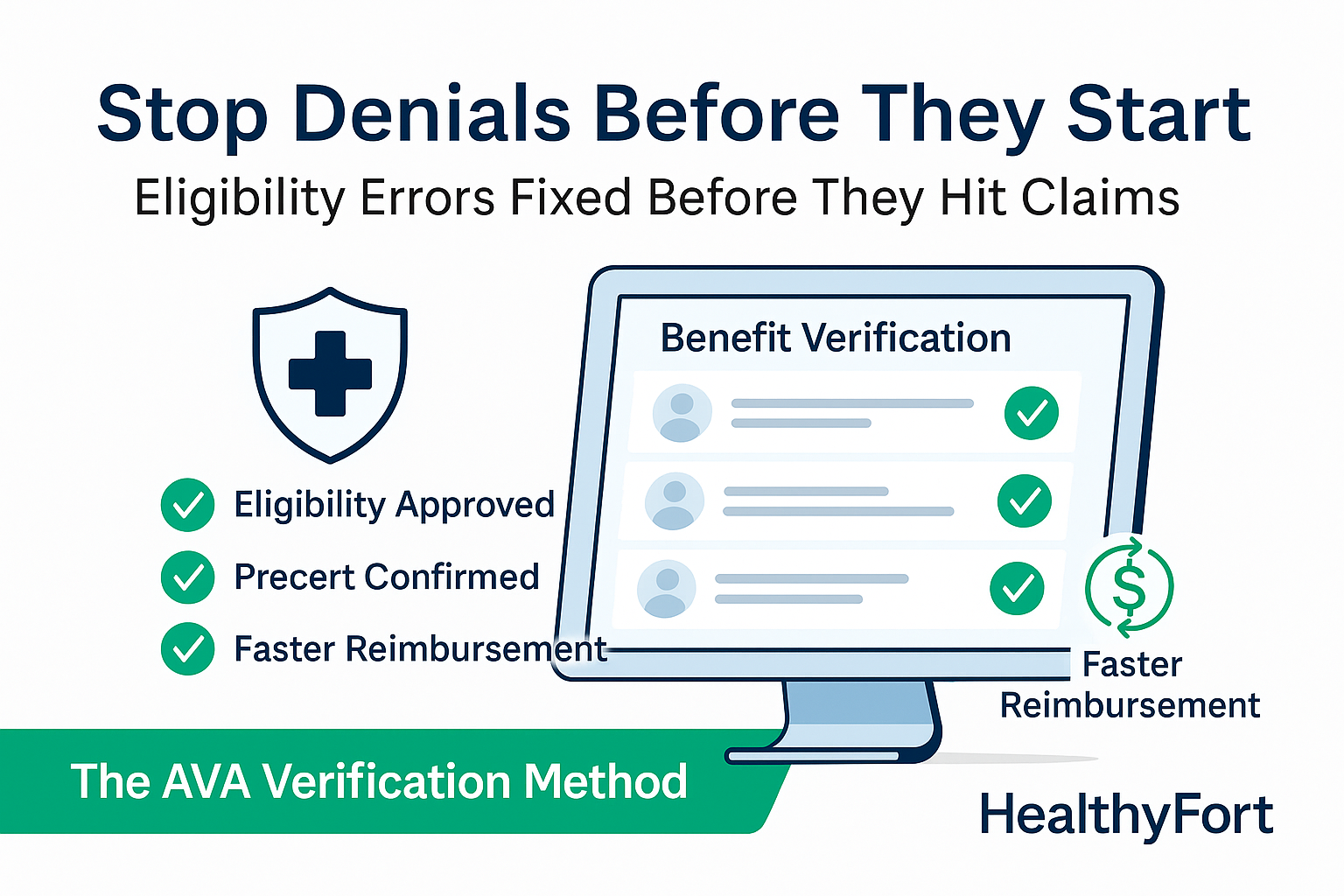
AVA Framework — Automated Verification & Assurance
Before the steps: AVA is a simple control loop. Automate checks. Validate details. Turn failures into tasks. That’s the practical benefit.
Step A: Automate eligibility checks
Automate daily eligibility queries using batch jobs and on-demand pulls. Validate member status, effective dates, plan type, benefit limits, and authorization rules.
Use ASC X12 270/271 for EDI flows and CMS HETS guidance for Medicare transactions as technical references ASC X12 270/271 overview, CMS HETS 270/271 guide.
For quicker wins, consider commercial APIs that standardize responses and reduce manual lookups, for example Eligible’s eligibility APIs Eligible eligibility & benefits API.
Quick win: run a daily batch check for scheduled high-volume clinics to catch lapses before patients arrive.
Step V: Validate benefit details and precert rules
Validation confirms not just coverage but service-level detail: whether that imaging study needs precert, whether concurrent care rules apply, or if benefit caps exist.
Build rule sets that flag services requiring authorization and route them to care coordinators.
Use state Medicaid manuals and payer policy pages to keep rules current. CAQH CORE explains operating rules that standardize transactions and can reduce exceptions CAQH CORE operating rules.
Micro-example: flag a CT scan for prior auth if the patient's plan uses a radiology benefit manager. That flag should create a task automatically.
Step A: Assure via real-time alerts and workflows
Assure means converting verification failures into tasks with SLAs. Create exception workflows that auto-create tasks, send alerts, and escalate unresolved verifications.
Integrate alerts into your EHR/PM using HL7/FHIR or middleware; HL7 FHIR CoverageEligibilityRequest/Response is a practical reference for API-driven checks HL7 FHIR CoverageEligibilityResponse docs. SMART-on-FHIR guides show how to embed these alerts into clinician workflows SMART on FHIR integration examples.
Set targets: 24-hour SLA for scheduling teams and 4-hour SLA for day-of-service issues. Measure the time from alert creation to task resolution.
AVA in practice — HealthyFort Services example (Promotion #1)
Dr. Sarah’s billing team ran a two-week pilot focused on outpatient radiology. Baseline: eligibility-related denials accounted for 28% of denials. HealthyFort automated eligibility pulls, built payer rules, and created exception tasks routed to a two-person verification squad. Result: eligibility-related denials fell significantly and average days-to-payment shortened by several days. HealthyFort can share a demo or checklist to map a similar pilot for your department.
A practical note: label these pilots clearly. One team, one service line, 30 days. That keeps scope tight and results easy to measure.
Step-by-step implementation plan
Step 1: Assess current state
Export denial reasons for the last 6–12 months and rank them. Interview schedulers, registration, pre-cert, and billing teams to map manual touchpoints. Use CMS denial and remittance code lists to map claim denials back to front-end failures CMS denial & remittance code guidance.
Practical task: create a single spreadsheet that ties denial codes to the exact front-end step that failed. That spreadsheet is your project north star.
Step 2: Build verification rules and integrations
Translate top denial causes into concrete rules: membership active, coverage limits, prior authorization needed. Design the integration flow: EHR/PM → eligibility API → workflow engine → task queue. Prioritize HL7/FHIR or X12 270/271 depending on your vendor ecosystem. Availity and payer portals are useful during hybrid implementations Availity provider eligibility tools. Pilot rules in a high-volume service line like outpatient imaging or ambulatory surgery.
Step checklist:
- Map 3 top denial reasons.
- Build rule for each.
- Pilot on one clinic for 30 days.
Step 3: Train, monitor, and iterate
Run a time-bound pilot, measure denials prevented and staff time saved, then adjust rules. KPIs to set: percent reduction in eligibility denials, first-pass acceptance rate, and average days-to-payment. Review results weekly during the pilot and roll out incrementally. HealthyFort offers a starter checklist and can map a pilot if you need a vendor partner.
Pro tip: update rules monthly and after any major payer bulletin.
Common mistakes and how to avoid them
Mistake 1: Treating verification as one-off
Verifying only at registration is risky. Coverage changes and authorizations expire. Verify at scheduling, pre-service, and day-of-service. Automate repeated checks and flag any lapse immediately.
Mistake 2: Over-reliance on manual checks
Manual-only processes are slow and inconsistent. Use automation for routine checks and reserve staff for complex exceptions. Compare RCM automation vendors using KLAS reports when you shortlist partners KLAS denial management reports.
A short scheduler quote to illustrate the issue: "We’d spend an hour pulling eligibility only to find the auth had lapsed." That single sentence highlights why automation frees people for higher-value work.
Mistake 3: Ignoring payer-specific rules
Payer rules change often. Maintain a payer rule library and assign a payer-owner. Subscribe to payer bulletins and reconcile rule changes monthly. CMS provider-directory requirements and state Medicaid manuals are helpful regulatory references CMS provider directory requirements.
Measuring ROI and continuous improvement
KPIs that matter
Track percent reduction in eligibility-related denials, days in A/R, first-pass acceptance rate, and average time to payment. Use a 90-day pre/post window to calculate impact. HFMA and KLAS provide benchmarking data to set realistic targets HFMA denial-prevention resources. MGMA helps estimate cost-to-appeal savings MGMA denial cost benchmarks.
Mini KPI snapshot:
- KPI: Eligibility-related denials — How to calculate: (eligibility denials / total claims) × 100 — Target: reduce by 20% in pilot.
- KPI: Days in A/R — How to calculate: average days outstanding — Target: drop by 5–10 days.
- KPI: First-pass acceptance — How to calculate: accepted claims / total claims — Target: lift by 5–10%.
Building a dashboard and reporting cadence
Build a minimal dashboard: denial reasons by category, time-to-resolution for verification exceptions, and staff time per denied claim. Use Power BI or Tableau for visualization. Report weekly to operations and monthly to execs. Set alert thresholds so regressions trigger immediate reviews.
Continuous feedback loop
Run quarterly retrospectives: review top denial drivers, update verification rules, and retrain staff. A/B test rule changes in pilot clinics before systemwide rollout. Document successful rule changes as SOPs and share wins with leadership to secure ongoing investment. For deeper strategy resources, HFMA and AHA publications are useful starting points HFMA resources, AHA denials resources.
FAQs
- How often should we run eligibility checks?
At scheduling, pre-service, day-of-service, and daily batch checks for active cases. - What’s the difference between eligibility and benefit verification?
Eligibility confirms coverage; benefit verification details covered services, limits, and copays. AAPC explains the distinction clearly AAPC benefit verification. - How to handle retroactive denials after verification?
Log the denial reason, escalate to appeals when coverage error exists, and use the case to tighten rules. - What metrics prove ROI to a CFO?
Show percent denial reduction, days in A/R improvement, first-pass acceptance lift, and estimated appeals cost savings using MGMA benchmarks MGMA denial cost benchmarks. - Which integrations to prioritize first?
Start with EHR/PM → eligibility API → workflow engine. Use SMART-on-FHIR for modern APIs SMART on FHIR integration examples. - What privacy issues apply to automated verification?
Use HIPAA-compliant APIs, encrypted transport (TLS), and follow CMS HETS guidance for Medicare transactions CMS HETS 270/271 guide.
Conclusion — Next steps and CTA
Proactive, automated benefit verification stops many denials before they start.
Immediate next step you can do this week: export your top three denial codes, map them to the front-end step that failed, and pick one clinic to pilot verification rules for 30 days.
Download the verification checklist or schedule a HealthyFort demo to pilot the AVA framework and commit to one measurable pilot metric this quarter. Quick step: pick one clinic and target a 20% drop in eligibility denials this quarter.